
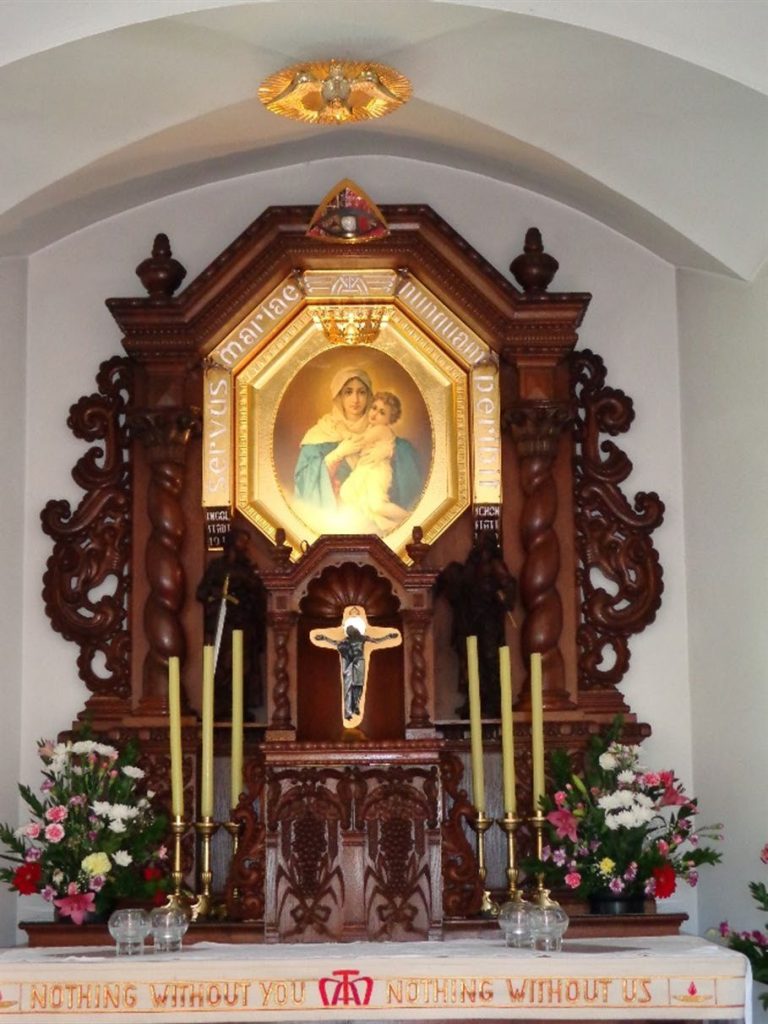
17 February 2022 · 2022-02 newsletter
“Schoenstatt’s Way: Authentic Witness to Holiness”
Dear Schoenstatt Family and Friends,
Greetings and blessings for this Covenant Day – 18th February. In the liturgical year we are currently in Ordinary Time, although we will soon be approaching Ash Wednesday and the season of Lent.
We might think that during the “Ordinary” time in the Church’s year, nothing much will be happening. But this is not true, just as it is not true that the ordinary times in our own life is a time when nothing special happens. Why do I mention this? Because for most of us, the ordinary things are what make up much of our life and it is during these times that we are asked to be witnesses to holiness.
As you are already aware, this year our national focus is on looking at how we can live our apostolic life through Schoenstatt, as an “authentic witness to holiness”. However, before we can witness to holiness, we need to understand what is meant by “holiness” and specifically, how do we define this in Schoenstatt?
The everyday saint is not defined by extraordinary visions or deeds. The everyday saint lives his/her state in life and fulfils his duties according to the motto, “Do the ordinary things extraordinarily well out of love for God” The result will be a saint who is both keenly religious and deeply natural. As Father Kentenich liked to say, “The most supernatural person must also be the most natural one.” He contrasted this with the “Sunday sanctity” of Christians who go to church on Sunday but do not allow their faith to affect the rest of their lives.
This is the secret to connecting faith with life at its most basic level. If God is so real and personal to me that I can do everything for him, then everything can be a way to holiness. In Schoenstatt’s experience, this love of God is especially anchored in a practical faith in Divine Providence and in a deep and effective covenant of love with Mary.
Everyday sanctity (or holiness) has many facets. As already mentioned, it can be described as “doing one’s ordinary duties in an extraordinary way” or as “fulfilling the duties of one’s state in life as perfectly as possible.”
However, both of these descriptions are dependent on doing these “ordinary things” … out of love for God. In 1932, Father Kentenich gave the following definition:
Everyday sanctity is the God-pleasing harmony between whole-hearted attachment to God, work and fellow-man in every circumstance of life.
In a retreat for Priests in August 1932, Father Kentenich said in speaking about holiness and God’s activity in our lives:
“Everyday sanctity (holiness) keeps the commandment, “Remember to keep the Lord’s Day holy” (Ex 20, 8). But it almost wants to stress even more the words: Remember to sanctify your ordinary life. For the everyday saint, daily prayer and practices are the leaven which penetrates all of life, especially everyday life – holy is the one who lives a holy life, not the one who dreams of holiness or has the great ideal of holiness. What matters is taking the great ideal and using it to shape ordinary actions. The everyday saint is aware of the great chasm between ideal and reality. He is therefore not a preacher of the word but tries to overcome this divide in his own life.
(….) What do we actually mean by “holiness”? Holiness is God’s life in us. Or: our sharing in the divine life given to us through Jesus by the Holy Spirit who dwells within us. Our task is to defend it, foster it, and make it useful. We therefore sense a division of labour at work in our sanctity. The main part, objectively speaking, is taken by God. We are therefore aware of the Triune God as the principle cause of our spiritual life, with Christ as the causa meritoria (meriting cause). But this does not mean that we should just put up our feet and let God do everything. We have a supporting part. We are called to defend, foster and make fruitful this divine life. We defend it against the enemies of divine life through self-denial and the spirit of penance. We increase it through reception of the sacraments and virtuous works. We make it fruitful through apostolic activity and by passing on the gift of life. (….) This corresponds to our subjective need. We moderns have become tired because we have viewed sanctity too much as something self-made. This is why the shift of accent in favour of God’s action has been so liberating for us.
May our striving for holiness, make us authentic witnesses through the strength of our Covenant of Love with our Mother Thrice Admirable, Queen and Victress of Schoenstatt.
United in our Covenant,
Shirley Hall
Filed underNewsletter · Reflections