
19 March 2025 · 2025-03 newsletter
United in the Covenant – Pilgrims of Hope
Dear Schoenstatt Family and Friends,
Wishing you many blessings for this Covenant Day- the 18th March. We are now in the season of Lent, a time for preparing for the great celebration of Easter. During Lent we are asked to give special attention to our prayer life, fasting and good deeds and in this Jubilee Year, to do so in a spirit of hope and joy.
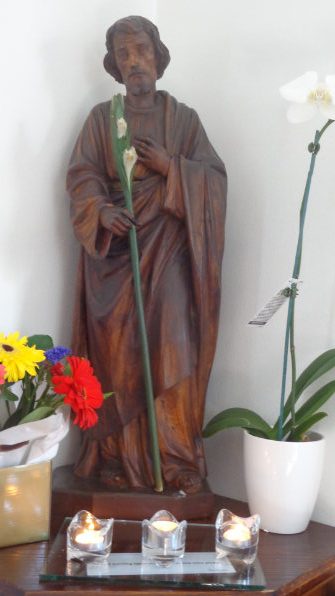
As tomorrow will be the Feast of St. Joseph, I would like to share with you an extract from a sermon given by Fr. Kentenich during a Mass at Mt. Schoenstatt, Germany in honour of St. Joseph on 18th March, 1967.
Fr. Kentenich began by considering what our most fundamental attitude is to God the Father. What does this fundamental attitude look like and how St. Joseph can be an example for us also as a pilgrim of hope.
“To summarize what Sacred Scripture has to say [about St. Joseph] is to admit that little is said in terms of words. We find very little about St. Joseph. In both the Bible and in our souls, he stands before us as the man of action. He doesn’t talk much—he acts! And if we would want to put his basic attitude in a nutshell, we would probably have to say that his entire life embodies the petition found in the Our Father, ‘Our Father, … thy Kingdom come,’ the Kingdom of the Father! ‘Thy will be done on earth as it is in heaven!’ Your will, the will of the Father!
Not my will, not the will of the tyrants and dictators, no, your will be done on earth as it is in heaven. A brilliant Frenchman once ventured the opinion that the words ‘Thy will be done’ go beyond all others.
And if we would now ask why they go beyond all others, I think we would have to admit from our own experience: No words are greater in the mouth and heart of a Christian, and no words are greater in the ear of the eternal Father-God. (….)
Turn now to Sacred Scripture. There you will find a few practical hints as to the particulars…. We hear about St. Joseph’s great dilemma. … a single word from heaven is enough to suddenly resolve the difficulty. Dispelled were all his questions about the honour of his bride, all the doubts he struggled with in his heart. The message from above: ‘Do not fear to take Mary, your wife, to yourself’ (Mt 1,20). What followed? He followed! In other words:
‘Yes, Father, yes, your will be ever done,
whether joy or pain or sorrow from it come.’Your will, your fatherly will, should always be done! In the great difficulties of the Holy Family, Joseph always relied on God’s word from above: ‘Get up, take the Child and his mother, and go to Egypt!’ (Mt 2,13).
Here we can sense how clear and yet how difficult it was to carry out this directive. What followed? [He followed! —] ‘He got up…’ (Mt 2,14). Do you grasp the meaning of this? ‘God’s will, be still!’ ‘Nothing is mere coincidence; everything comes from God’s providence!’
And when those who wished to kill Our Lord had died, Joseph was told to return to the land of Israel which he had left behind (cf. Mt 2,19-21). What followed? He followed!
What is the meaning of this fundamental attitude of conformity to the will of God as seen in the life of St. Joseph? This is the same as asking what the meaning of the yes is, the joyful, grateful, happy yes to all the things God the eternal Father does and permits in our lives, and to the ways he expresses his wish and will.
That is our starting point for peering more deeply into the realm of the supernatural life, into the order of salvation. (….)”
(Talk on Mt. Schoenstatt, March 18, 1967 as translated in Schoenstatt’s Instrument Spirituality, Chapter 9).
Wishing you many blessings and graces from the Shrine during this Lenten season.
May Our Blessed Mother be with us so that we may prepare worthily for the great blessings of Easter, through our striving in our prayer life, our fasting and our good deeds.
United in our covenant – as Pilgrims of Hope
Shirley Hall
Filed underNewsletter · Reflections