
16 October 2023 · 2023-10 newsletter
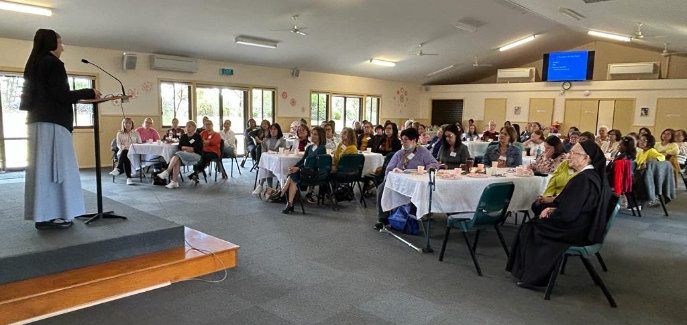
The above title was the topic for what was a wonderful getting together of women from all over Sydney for the second of our ‘Women’s Breakfasts’ run by the women of the Movement. Sr. Lydia Allen RSM PhD, the guest speaker, did a wonderful job of combining the psychological ego discipline of ‘Transactional Analysis’ with the spiritual discipline of being a ‘child of God’. Michelle from the single Women’s Branch replied with a Schoenstatt perspective of what ‘to educate the child in me’ meant to her as a young girl growing up in the Movement through to a full adult understanding of what this means to her now. Many women were surprised at how the idea of the childhood aspect of ourselves still has a profound impact on how we act and respond as adults and parents.
Attendees at the Women’s Breakfast were very grateful to our two speakers for new or reinforced insights and returned home conscious that we need to be aware of the different ego states of being a child, adult and parent interacting within us and in particular that we need to strive to allow our intellect and will to be more in control of our emotions if we want to grow to mature womanhood. I would like to add a few thoughts from our father and founder, Fr. Kentenich, that can further our understanding of the need to educate the child within us.
Fr. Kentenich on educating the child in me
Fr. Kentenich spoke of the “Tree of Womanhood” – mentioned by Michelle – where the roots are childlikeness, the trunk, selfless motherliness and the fruit, intuitive wisdom. Just as it is important for the roots of a tree to be sound, this implies that, as women, (this also applies for men) we need to be safe and secure in the knowledge and experience that we are, through Baptism, children of God, and will always remain so.
Fr. Kentenich reminds us that “normally a child should grow up within a holistic organism of attachments. A child should grow up with bonds to places, people and ideas”. He further explains:
“All the threads of a person’s soul must be bound on the natural level. If they are not bound, or there are insufficient bonds, the soul suffers a terrible break. The normal development of the human person is dependent upon an organism of attachments, the person must be attached to people, places, and ideas”.
Fr. Kentenich states that in the normal way:
“Our soul needs more than attachment to ideas; it also needs attachments to places and, before all else, to persons. Man can only take root and grow to spiritual maturity through other persons, through attachment to other persons. A human being without these manifold roots in the lower order, the natural order, shares the fate of a tree without roots. Such a person is quickly uprooted and fails to grow deeply enough into the higher order, the supernatural order.”
Thus, when the bonds to people, places and values are positively developed in childhood, these relationships make a person self-confident and strong. And we may not forget that even as mature adults we are children of God throughout our whole life.
As a help for our striving to balance the child, adult and parent experiences within us, Michelle pointed out how the Shrine becomes a home for a person when they encounter it. There God and our Mother can take on the parent role, so to say, in a way that can combat former parental influences that may have hurt. The Shrine becomes our ‘common home’.
To become part of the Schoenstatt Movement offers the adoption of new sisters and brothers, who have become stronger and more well developed because of Schoenstatt in their lives. And the most important element of the newly found attachment is the ‘Covenant of Love’ where Mary our Mother promises to guide us in the right way so that we come to the point where we realize there is “Nothing without Her” but also “Nothing without us”.
As Mary intercedes for us the grace of transformation, we strive to ennoble the emotions and limitations we experience within us. We want to reach out to educate the child within us.
We realise that, as Fr. Kentenich said:
“becoming children means growing in the likeness of the God-man. The God-man, the only begotten Child of God, should take form in us ontologically and form our lives.”
Fr. Kentenich also posed the question for us:
“Why will Our Lady lead us to a deep childlikeness toward the Father? It simply lies within her responsibility as the mother in the family of God; as a mother, she knows that this childlikeness is the key to our true happiness. How does she know that? Because she experienced it, because she knows that a true childlike yes to the wish and will of the Father makes for our greatest happiness and bliss.”
Be it our families, communities, or nationality which have developed attachments and experiences in a myriad of ways, more than ever it is necessary that we cultivate the attachments offered us in Schoenstatt. It is in the Shrine with Mary as our mother and Fr. Kentenich as our spiritual father where we can become a child of God and Mary, and an adult working fully with the Holy Spirit. Through the transforming grace interceded for us in the Shrine, as parents (natural or spiritual) we can lead others to God and higher values. As Fr. Kentenich assures us, natural attachments will help us find genuine supernatural attachments which provide stability and natural / supernatural health.
Angela
Filed underNewsletter · Reflections