
21 August 2023 · 2023-08 newsletter
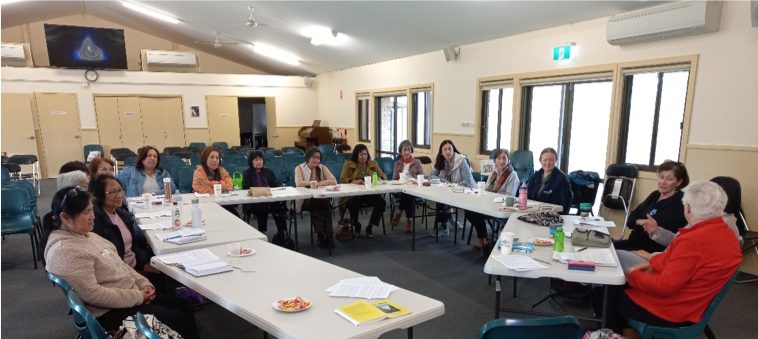
On Saturday 12th August, approximately 20 women from the Mother’s Branch and one member of the Single Women’s Branch came together for a time of formation. The topic was a continuation of April formation day which focussed on Schoenstatt’s Third Milestone – the 31st May, 1949.
Sr. Elizabeth who presented the day, firstly shared a video about the 31st May, the events leading up to it and those following on from it in the life of Father Kentenich. She then went into more detail about some of the reasons why Fr. Kentenich felt it necessary to write a letter to the Bishop of Trier in response to the findings of the Episcopal Visitation that had been conducted in Schoenstatt.
While the results of the visitation were overall generally favourable to Schoenstatt, Father Kentenich wanted to address the concerns he had about the state of the Church and society. He believed that he needed to act out of love for the Church and Our Lady. He said, “Tua res agitur, clarificata te” – “your work is at stake, now glorify yourself.”
When Father Kentenich placed the first part of his letter on the altar in the shrine at Bellavista, Chile, he said, “We can only face the coming battle in the strength of the Holy Spirit. We need the gift of the Holy Spirit.” This was very meaningful as this act took place on Pentecost Sunday.
Sr. Elizabeth spoke about how over the centuries the Primary Cause has been separated from the “secondary causes”. That is, God is the prime mover or Primary Cause of everything, and His creatures and related things are “secondary causes”. God uses these secondary causes – created things and human beings – and they are intended to lead us to Him, to help us to attain attachment to Him. However, an understanding of this has been missing for many people, who don’t see God in the ordinary, everyday things and situations of life.
We shared some examples that relate to practical everyday life. For example, think of a person, in isolation from family, friends and colleagues and how this might seem the best way to understand the “essence” of the person. But can a person be truly understood without knowing their family and friends?
In the same way, we can go straight to Christ, or the Heavenly Father, but it is a much richer experience if we come to Christ through Mary, and they lead us through the Holy Spirit to the Heavenly Father.
We looked also at the role of the father in the family. If the father is no longer seen in the right way, then God’s Fatherhood is not understood in the right way. The same applies to the role of the mother in the family. Both the mother and the father are “stepping stones” leading their family to God. It is through the parents, that the child learns about God and is led to God, and to Mary.
Sr. Elizabeth also spoke about what Father Kentenich called, “mechanistic thinking” and how this separates ideas from life, God from secondary causes, life process that belong together and ideas that belong together. She then spoke of what Father Kentenich called, organic thinking as a counterpart from mechanistic thinking. It relates ideas and life, God the Primary Cause with secondary causes, life processes that belong together and ideas that belong together.
An interesting aspect of the day for the ladies, was looking at the role of women in relation to mechanistic thinking as opposed to organic thinking. For example, if I am a woman, I must recognise what my task is as a woman, within the framework of creation. I cannot try to do this as a man, or in a manly way. In this way I am become a ‘secondary cause’ in fulfilling my proper function in relation to others.
With this in mind, we looked at the statement that today many women don’t want to be ‘like Mary’. They don’t see Mary in her rightful place nor with the right attitude. For example, they see her as a ‘handmaid’, meaning for them, a ‘servant’, a ‘slave’ to others. They don’t see Mary as a strong, dignified woman as exemplified through her life. This loss of identity of womanhood has corroded the image of women in many ways, yet it is the woman who often influences the man, and it is the woman who to a large extent influences society and culture.
In her relationship to God, a woman should be a child of God. Just as Mary was the handmaid of God in her childlike attitude, so too women should embody childlikeness. We spoke about how important it is for women to be true children of God, to be able to be children with each other. Not childish, but in coming together and having fun and a good laugh, it can not only allow us to get to know each other much better on a natural level, but it can also lift our spirits and help us to grow together.
It was a day of real ‘formation’ for all of us who attended, whether newer to Schoenstatt, or having been part of Schoenstatt for some time. It is always a joy for these groups to come together and share their knowledge, their experiences, and their gifts. This has been a real gift for our women’s groups in coming to know each other and form a Schoenstatt community of women.
The day finished with a prayer time in the Shrine in which we gave thanks to Our Blessed Mother for all her help in these turbulent times, in helping us to rediscover our womanliness and motherliness, and to ask Our Lady to help us live our mission in a truly Christian and authentic way.
Below is some feedback from the day:
- Thank you, Sister Elizabeth, for our wonderful formation day. I really got a lot out of the topic: the third milestone.
- It was good seeing others from our mothers’ groups. I really enjoyed the formation and discussions. Thank you.
- Thank you, Sister Elizabeth, for conducting the formation day yesterday. It was very meaningful, and I still have lots to learn about Schoenstatt.
Thanks to all who attended the day and contributed to the friendly, collegial spirit of sharing and supporting each other as part of the women’s branches of Schoenstatt.
Filed underEvents · Newsletter