
19 January 2026 · 2026-01 newsletter
Last month we celebrated 60 years since the return of our founder to Schoenstatt after 14 years of exile in the United States. Fr. Alexandre Awi Mello, the president of the General Presidium, invited all to a Mass in the Adoration Church on December 17 to “give thanks for the powerful intervention of our Blessed Mother, our MTA, in our history. It is always important to try to understand the ways of God in our lives and in this case in the life of our founder and our Schoenstatt Movement.” For more articles about this milestone in our history visit “News and Articles” in the website: Schoenstatt.com. There is also a short documentary about the history at the same location: https://bit.ly/3LwzAqk
200 Questions about Schoenstatt by Fr. Jonathan Niehaus is a further resource from which the following extract (pp. 142-145) is taken.
The “fourth milestone” refers to the important historical events of 1965 (60 years ago) that resulted in Fr. Kentenich’s reinstatement and return to his work in Germany. The primary dates are:
- October 22: Pope Paul VI signs the decision of the consistory of cardinals that effectively drops all decrees against Fr. Kentenich (this day was exactly 14 years after Fr. Kentenich left Germany in 1951).
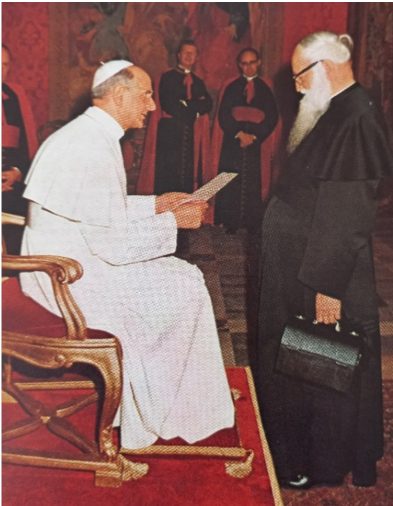
- December 22: Pope Paul VI receives Fr. Kentenich in a private audience. Fr. Kentenich promised that Schoenstatt will do all it can to help realize the mission of the Church in the post-Vatican-II era.
- December 24: Fr. Kentenich returns to Schoenstatt, Germany and celebrates his Midnight Christmas Mass in the Original Shrine. The return to Germany is sometimes referred to as the “second miracle of the Holy Night”. In a beautiful gift of Divine Providence, the actual day of Fr. Kentenich’s return from the exile years to Schoenstatt, Germany, took place on December 24, 1965 – indeed, the Holy Night!
The fourth milestone also coincides with the solemn closing of Vatican Council II (December 8, 1965). Fr. Kentenich, who was in Rome at the time, symbolically blessed the cornerstone for the future Schoenstatt Shrine in Rome (the Shrine that was later dedicated on September 8, 2004) and spoke of Schoenstatt’s part in realizing the mission of the Vatican Council.
Importance for Schoenstatt
Given its coincidence with the end of Vatican II, the fourth milestone is also connected with the mission of the Church “on the newest shores of the times”.
In this light, Schoenstatt not only has a mission for the Church (the mission of 31 May, 1949 – the third milestone), but also a mission with the Church as she works to accomplish the work entrusted to her by Christ. This co-operation, with the official structures and hierarchical leadership of the Church, took concrete form when Fr. Kentenich made a definite promise to Pope Paul VI. (see below)
Importance for Catholic life and faith
The fourth milestone can also increase our appreciation for the Church, bringing into focus not only what I can do for the Church, but also how my part is complemented by working together with all others for the one great goal of building up the kingdom of God.
Fr. Kentenich’s Promise to Pope Paul VI
On December 22, 1965, Fr. Kentenich was received by Pope Paul VI in a brief private audience.
Paul VI had prepared a text in which he personally expressed his thanks to Fr. Kentenich for his loyalty to the Church and for his founding such a tremendous apostolic work, which is so needed by the Church right now.
With this he confirmed his rehabilitation.
At this point Fr. Kentenich made the following promise in return:
“In the name of the Schoenstatt Family, I heartily thank you for the good works you have lavished on Schoenstatt to an extraordinary degree, but also for my personal rehabilitation.
In gratitude for everything which Your Holiness has done, we want to diligently work to help realize the unique mission of the post-conciliar Church for our modern times. And all of this under the patronage of the Mother of the Church.”
At this time, Fr. Kentenich gave the Holy Father a chalice for the church to be built in honour of “Mary, Mother of the Church”. As Fr. Kentenich stressed a few days later when he returned to Germany, it was Schoenstatt’s role to actively contribute to the realization of the mission which the Church had undertaken at Vatican Council II.
Filed underInternational · Newsletter