
30 September 2025 · 2025-09 newsletter
Many Catholics ask: Whatever comes out of all the church talk fests like Plenary Councils or Synods? Sometimes there is apathy; why bother getting involved in such gatherings when nothing ever changes? We have seen during this year of Jubilee, Pope Leo meeting with various groups within the universal church. On a more local level the Australian Catholic Bishops Conference Commission invited Ecclesial Movements and New Communities in Australia for a two-day Conference at Mary MacKillop Place at North Sydney.
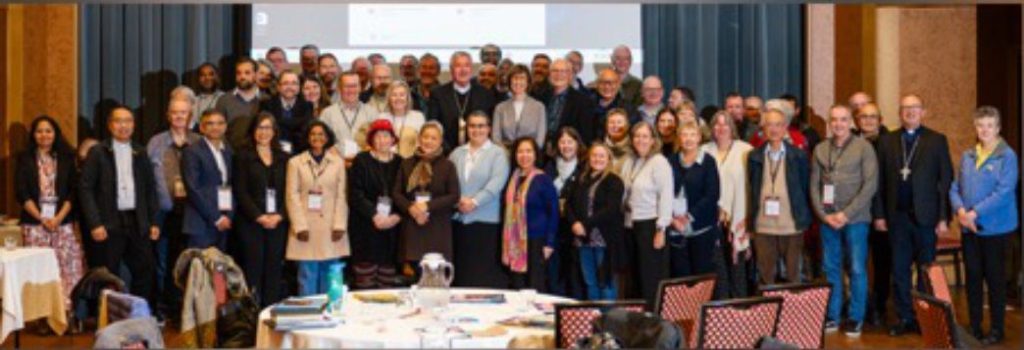
Sr. M. Rita and I were invited to represent the Schoenstatt Movement in Australia at this gathering, comprising 25 different ecclesial communities and movements (54 lay people). The conference was hosted by the Bishops Commission for Evangelisation, Laity and Ministry (BCELM). The event was the first gathering of new movements and communities in more than a decade. Seven bishops, Commission chair Archbishop Prowse of Canberra and Goulburn and the Bishops of Bunbury, Geraldton, Lismore, Melbourne, Port Pirie and Wollongong were in attendance. The theme for this gathering was: ‘Pilgrims of Hope: Charisms for the Mission of the Church’ and the key themes discussed were Evangelisation, Charism and Co-Responsibility.
The aim of this conference was to strengthen relationships and discuss ways to effectively collaborate for the service of communion and mission in local churches. There was a great energy and joy to meet each other, connect and enrich one another. There were many opportunities to hear how each movement has grown, developed and what it offers the people of God. One could really sense the Holy Spirit was truly at work and present during this fruitful conference. It was an amazing experience to see that the Church in Australia is truly alive, vibrant and that only through working together can we bring the message of the Gospel to all of Australia. It was very evident that movements are no longer on the fringes of the Church but are at the heart of the Church with a clear vision of our mission and what we have to offer the parishes and wider church
Our charisms are a gift from God given for the missionary work of the church. The two strongest themes that emerged from the first morning were: Relationships and building trust between Bishops and Movements and cooperation amongst the movements themselves.
It was stated that our movements have matured. Years ago, as fledgling groups, there could be a silent competition but now, as the groups have matured, it was acknowledged that people have different callings/missions and knowing the charisms of other movements allows people to find their right home, where they can blossom and use their particular gifts. Competition has matured into collaboration, as we need to support each other and build bridges, so we can lead people into the church – to know the mercy and love of God.
For me, it was interesting to hear many of the Charismatic movements are well into the planning for April 2033; the 2000th anniversary of Jesus’ crucifixion and saving act. I was shocked, I have not heard this anywhere else. I thought to myself as a Marian movement, it is 2000 years since Mary was given to us as our mother by Jesus from the cross and Mary as the image of the church. (Food for thought and pondering).
Archbishop Prowse in the welcoming address on the first morning shared that our movements are the garden from the seeds of the gospel. Bishop Brian Mascord closed the first day stating: “Do all you can within your means and leave the rest to God”, Christ is the gardener, and we are co-responsible for the Vision.
Day two opened with a Bishop being on each table to hear and be part of the sharing. We discussed how we bring hope through our various movements and individual charisms. Within this session it was emphasised that collaboration has to be the way into the future for our movements here in Australia and the realisation that being united as Catholics does not mean sameness but being open to the guidance of the Holy Spirit. Whilst movements are independent (not bound by obedience), we are called to be the leaven of Mission and Unity. We are co-responsible and walk in the footsteps of St. Peter and the Pope. We are called to listen and receive the Wisdom of tradition and the Magisterium, taken from an article by Cardinal Ratzinger re Vatican II (before being Benedict XV1) and the fact that this truth was also championed by Pope John Paul 11 was cited.
In the final session of the conference Archbishop Prowse shared how frustrating structures can seem to be to new movements, but we are called to bring newness into these structures as we have a heart for God’s Mission and the church.
It was hoped that sharing together has brought us to a deeper understanding and the “gift” each movement has to offer the church for which we have co-responsibility.
In his final address Archbishop Prowse also highlighted the significance of this gathering and particularly the place:
- Geographical place: Mary MacKillop Place – Australia’s first saint, the saint for all Australians, a pioneer and revolutionary for the Church in Australia.
- Scriptural place: The Cenacle at Pentecost (specifically in contrast with Babel)- we are called to unite around the blessed Mother and listen carefully to the Holy Spirit with the ears of our heart.
- Evangelisation: Place of Evangelisation is the lay movements where encounter, discipleship, mission is to be found.
The day ended with the questions: Where is God calling us (movements) now? How can I/we live the gospel now and a deeper question why now? Where is our Charism most useful?
More information regarding this conference can be found here: Bishops meet ecclesial communities and movements – CathNews
Michelle Davis – Women’s League
Filed underEvents · Newsletter