
18 May 2026 · 2026-05 newsletter
A collections of reflections from those who made the journey.
Members of the Western Australian, United Hearts for Grace, Family Group, journeyed to Tardun, reflecting on the place where the first Schoenstatt Sisters began their mission in Australia. Below are some of the personal impressions and experiences from those who took part.
First Impressions of Tardun
Brad
On arrival at the Pallottine mission after a two day, 450km drive, it felt like a very special and peaceful place. Especially in the chapel, the monastery, accommodation and workshops.
I am sure our Lady was there with us.
Standing in the hot sun and dust, it was daunting to think of the magnificent contributions to the capital of grace, the sisters offered in their mission work during the 1950s. Their devotion to Our Lady paved the way for Schoenstatt here in Australia.
Philomena
I found the place interesting but very remote. The Sisters must have learnt to be resilient and must have had great faith that God and the Blessed Mother would take care of them. I don’t think they could have left even if they wanted to.
The Journey and Experience
Terry
We were faced with oversized vehicles demanding all of the road and forcing us to wait off the main surface for them to pass; there were numerous roadworks which either slowed us down or stopped us in our tracks momentarily. We spent time together for morning tea and lunch and travelled at our own pace admiring the passing scenery. At each stop, we met various people who provided us with either interesting historical facts or just helpful information regarding the local area.
However, our journey was not complete when we arrived at the Wandalgu Mission site, but the time we then spent having a guided tour around the site itself provided another layer. There is not much left of the original ex-army buildings as a rebuilding program was started in the 1960s, however, we were still able to get a feeling of just how isolated and harsh the settlement must have been. One building which has survived is the Sisters’ “convent” which was finished in 1957. And, again, walking in and around this building, although in need of some maintenance, we could certainly see just how the Sisters lived.
The journey, including the 10kms of dirt road, the company, our welcoming hosts, our shared time in prayer, reflection or activity all added to an amazing, but all too brief, pilgrimage. It was a wonderful experience to be at the place where Schoenstatt first put down roots in Australia.
Ann-Maree
The Pallottine Mission known as Wandalgu is still as remote as it was for our original Sisters in 1951. Our journey was in the comfort of modern cars and the last 10kms is still a dirt road and this would have been our Sisters introduction to the Pallottine Mission.
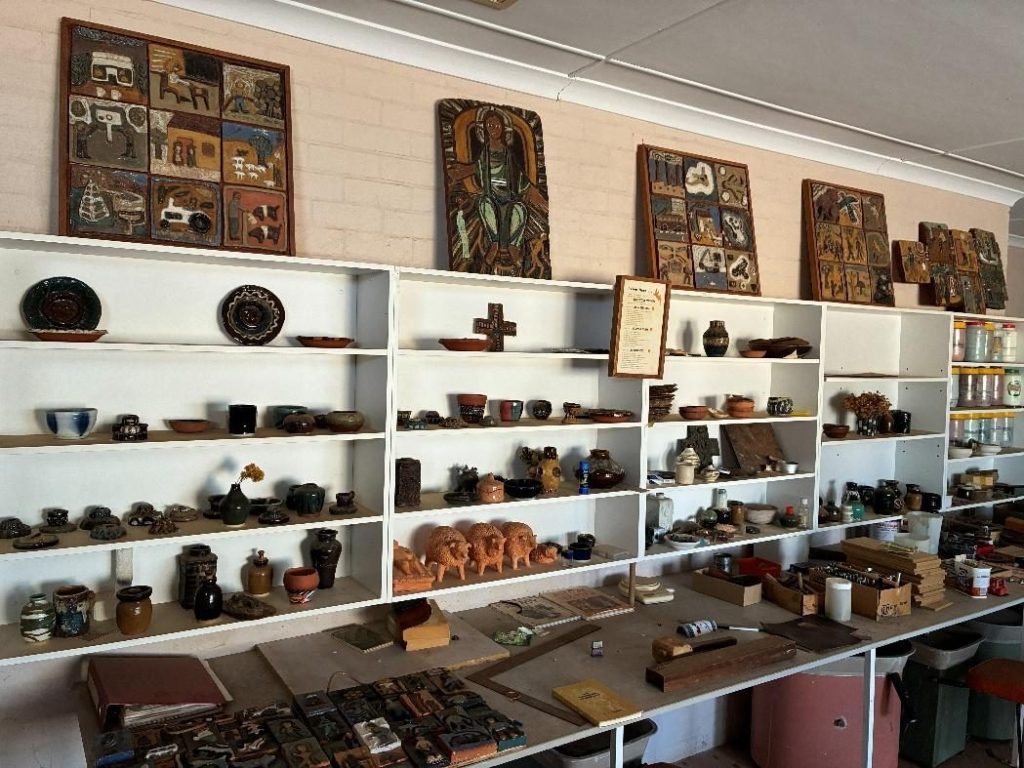
Wayne and Bonnie, the caretakers for Sun City Church, the new owners, took us to many of the buildings still requiring major repairs. One of these buildings will eventually be a museum, basically just a holding room and it was wonderful surprise to see a large photo of Sr. M. Bonitas with a group of indigenous students. Another find by Wayne and Bonnie was all the student art and pottery left behind in 2004. Looking through the vast pottery items, I was excited to find a flat piece of pottery with a raised MTA, forty years after our Sisters left Tardun, certainly Divine Providence.
Places of Encounter
Lina
Arriving at the Wayside Shrine I prayed with my mouth closed for a fly net to magically appear. Funny enough it did from the caretaker Bonnie.
After that experience I was pleased that we went inside St Joseph’s Church and was in awe of the most beautiful artwork of Jesus on the Cross.
The Pallottine’s monastery has a chapel in it that is shaped like a Schoenstatt shrine. A great piece of architecture in the middle of nowhere. Just then you see a bright light coming from the sun’s rays beaming on the colourful stain glass windows. It’s glorious.
In this peaceful place, a flock of birds fly overhead and you can almost hear the sound of children once playing in the school grounds 75 years ago.
This land has a happy feel to it and brings joy to one’s heart. Our family group bonded closer together as we cooked, prayed and played around with a few activities.
Terry
For me, one highlight was finding a wayside Marian shrine, which was built in 1952, on the side of the entrance road. Although not an MTA shrine, there was a Madonna and Child relief within the structure indicating that the site was and is under Mary’s protection.
Personal Connections
David
As a member of this family group, I was eager to experience, for myself, this isolated mission in mid-west Western Australia.
Although, over time, ownership and physical structures may have changed, I somehow felt connected with these brave Schoenstatt sisters as I watched the same sunrise and sunsets as they did. They were here those many years ago. Now it’s my turn.
Ann-Maree
The first wayside Shrine is still standing and built in a style of the Original Shrine, although the MTA has faded over the last 75 years. I think our Sisters must have resided in this part of the property. The Wayside Shrine connected me to our original Sisters and to all our Sisters in our Schoenstatt Community through our MTA. I found this to be an emotional experience.
Gesture of Gratitude
As a parting gift, we presented our hosts with a framed, signed MTA. It is hoped that all who visit and work at the mission will be blessed by seeing our Lady.
These reflections highlight not only the history of Tardun, but the living connection each of us experienced with the mission of the first Sisters.
Filed underCommunity · Newsletter