
18 February 2026 · 2026-02 newsletter
The following is an abridged version of Sr. Helen’s video presentation for the January Covenant Day. For a full copy, please contact Shirley: movtoffice@schoenstatt.org.au
“In the prayer that our sisters worldwide are praying each day in this centenary year of the foundation of our community, there is the sentence: HELP US TO GO OUR WAY AS A FAMILY WITH INITIATIVE, JOY, AND TRUST. To my mind, in what I experienced in the five years in Ashfield 1961 to the end of the year 1965 in New South Wales, the sisters showed remarkable faith, trust and hope.
Looking towards the future
The first sisters arrived in WA in 1951. With the arrival of five additional sisters in July1956 and with future development in mind, Sister Aloise recognised the need to have sisters in a more densely suburban situation and so, from 1958, some of the sisters were teaching in the Catholic School in Riverton, a suburb of Perth. Around the same time, it was decided that two would go to Sydney to prepare and complete a teachers’ training course. First one and then the other. The “other,” cared for an elderly lady Mrs O’Neil, both lived in Mrs O’Neil’s house in Vaucluse.
How things were when I entered in 1961
When I entered the Sisters’ community in February 1961, both Sister Anita and Sister Mariwarda had teaching positions in Catholic schools as lay teachers. Sister Mariberta had been transferred from Western Australia to become the extern sister living in Vaucluse, looking after Mrs O’Neil.
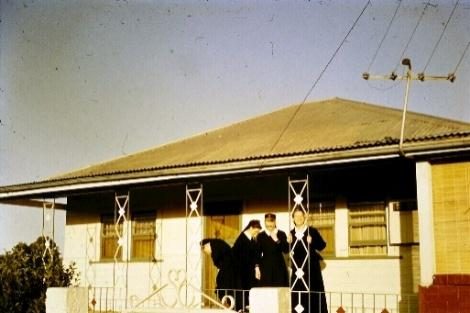
Sister Aloise was already in Sydney – a flat had been rented and then a house bought in Ashfield on 21 July 1960. It was a large federation house at 1 King Street Ashfield, and an extension was built so that it could include a hostel for country girls working in the city. Besides the girls in the hostel, who were the sisters?
The Sisters in Ashfield in1961
There were already Sister Aloise, Sister Anita, Sister Mariwarda, Sister Aegidis in Ashfield, with Sister Mariberta – the extern linked to the Ashfield community. Sister Ann and I arrived on February 3. 1961. We were to go to the Catholic Teacher’s College in North Sydney; I was to help Sister Ann with her English. Only much, much later, I discovered that my time of postulancy was indeed quite unusual. Parishoners called me “the apprentice.”
How things were in Ashfield
Although I hadn’t come from an affluent family, I did notice that there were signs of poverty at the Ashfield house. There weren’t enough chairs for everyone in the chapel. Later, the Catholic Women’s League gave us unneeded chairs from their residential facility in Strathfield. Sister Mariberta reupholstered these and they are still in use in Mulgoa today! Weekdays, the priest used to stay after Mass for breakfast. The teapot had a lid that didn’t fit!
The Sisters of Charity gave us a large wooden cupboard that proved very useful for Sister Aloise to store office materials. Along with it, came a delightful statue of St Joseph the Workman, still honoured today in the province house in Mulgoa. In the street close to the Ashfield railway station, was a very popular cake shop run by three sisters. Often a phone call would come asking if someone could come – and there would be a bag ready to be picked up. I was the one to go. The youngest of the three sisters used to make me feel I was really doing them an honour.
The importance given to contributing to parish life
Having done parish work previously before coming to Australia and having been a superior, Sister Aloise was aware of how important it was to be involved in the parish. It was arranged that after school, Sister Anita would help in the very large sacristy.
Sister Aloise visited the nursing homes – talking to all – but having a keen eye for the Catholics. One afternoon coming back from visiting, we met a young German mother in King Street.
Responding to urgent need
Having the hostel in Ashfield and the house, being close enough to walk to from the railway station, the Catholic Welfare Office in the city sometimes rang to ask if a person could stay the night. Certainly, they were women in need. Each one, Sister called “Marooshka,” I didn’t know what it meant, or the meaning of the name – but it was always said with gentleness and respect. I was never told details.
Teamwork among the group
Looking back, I realise that what happened at the house in Ashfield, was indeed teamwork. Sister Anita taught a Year 5 in Ashfield and in the evening spent time with the girls in the hostel to see how they were going. Sr Mariwarda taught in Richmond and went there early Monday morning by train, returning Friday evening. On feast days, she often did the cooking to help Sister Aloise out, who did the shopping and cooking throughout the week, the finances at the end of the month. On her days off, Sister Mariberta travelled from Vaucluse to Ashfield and back, by public transport, did the week’s laundry and ironing, cleaned the house and did what she could in the time left to look after the garden. Sister Aegidis who wasn’t well, looked after the sacristy and the priest’s breakfast. The three studying were Sister Aegidis, Sister Anne and me.
Help from neighbours appreciated
Mr and Mrs Clements owned the two-storey house next door. They had borders and the first Schoenstatt league member was Joan Humphreys who lived there with her mother. After her mother’s death, Sister Aloise did a lot to help her in the weeks and months that followed.
Blessing of the extension by Cardinal Gilroy
It was in 1962, that the large extension of the house was built, to provide more single rooms for girls and sisters. With the renovation, the chapel was enlarged. Cardinal Gilroy blessed the chapel and extension on 31 August 1962.
Sister Felicia’s first visit to the region from the motherhouse
Towards the end of 1963 into early 1964, Sister Felicia, in charge of the English-speaking countries, visited the sisters in both Western Australia and New South Wales. It was the first visit from the motherhouse since the sisters had arrived in Australia. Father Kentenich was still in Milwaukee, and we heard many details that were previously unknown to us. The future of the region in both Western Australia and New South Wales was discussed and the longing for a shrine to be built was strong; yet it was obvious that it would only happen in the unknown future. The movement currently didn’t exist, in either state. On 31 May 1962, a wayside shrine had been erected in the garden at 1 King Street Ashfield. Sister Aloise had invited friends and neighbours for the blessing.
The longing that a shrine would be built
It seems that Sister Felicia understood both the situation and longing of the sisters for a shrine. A foundation stone for the future shrine was bought and presented to our Mother Thrice Admirable in the house chapel at Ashfield on 20 January 1964. It was decided to order the shrine altar – although at the time, there was simply no possibility that a shrine would be built. The altar arrived by ship, on 5 August 1964, as part of the luggage of four sisters who had arrived in May by plane – Sisters Inez, Henriette, Brenda and Lucy Ann. What excitement there was as it was unpacked and assembled, then placed in the house chapel.
Bishop Jobst introduces Father Patrick Archbold to Sister Aloise
One afternoon, Bishop Jobst arrived at the house in Ashfield with Father Patrick Archbold. Father Archbold was seeking a community to help build the parish that he had been recently appointed to – Mt Druitt. Bishop Jobst introduced him to Sister Aloise. After gaining permission from Cardinal Gilroy in Sydney, that the sisters could work according to the principles of Schoenstatt, it was decided that two sisters would begin in the newly created parish of Mt Druitt.
Two sisters begin in Mt Druitt – the start of the movement
Sisters Mariwarda and Loretta began in Mt Druitt on 18 January 1966. Sister Mariwarda had been a sister for the pilgrims in Schoenstatt, before coming to Australia. Both now had a teaching qualification from the Catholic Teachers College in Sydney and could be employed by the Confraternity of Christian Doctrine to give Special Religious Education in Government Schools. At the time, all the schools in Mt Druitt were Government schools. It was only much, much later a Catholic School was established in the parish.
The Shrine is built at Mt. Schoenstatt
With the establishment of the movement, land was found at Mulgoa for a shrine and centre to be built. The first holy Mass was celebrated in the unfinished shrine at Mt Schoenstatt on 20 January 1968 and in that same year on 19 May the blessing and opening of the shrine took place with Cardinal Gilroy as the main celebrant. For this occasion, Father Kentenich wrote a letter that is treasured by the movement today.
Following the development of the movement from afar
I was transferred back to Western Australia and followed the development of the Movement in NSW with interest. As the Movement grew, the Joseph Kentenich House in Mulgoa became known as a retreat centre, but the house needed to be extended. To have the finances to make this possible, I King Street, Ashfield was sold in 1980.
My appreciation
I am very grateful for the five years I had in Ashfield. As I see it, responding to the needs of others in the here and now, was an important value for the sisters. Deep loyalty to our father and founder was alive. Everyday upheavals seemed to be taken in one’s stride, convinced that Our Lady was their partner in the covenant of love. Among the sisters, I had seen generosity and sisterliness in everyday life, in a variety of situations. There was evidence of the endeavour to live everyday sanctity, according to one’s ability. Not that differences of opinion didn’t occur – but the bigger picture seemed to be held as more important and take precedence. Maybe the words, written by Sister Bonitas after her arrival in Australia, in some way includes and captures what I mean. She wrote:
“With courage and trust
we have started to do our work.
Our Lady has sent us to this place.
May her blessings be with us
so that we will be
willing instruments in her hands
for Schoenstatt and the
glory of the Triune God.”
Sr. M. Helen Ockerby
Filed underNewsletter · Sisters of Mary